Many people, it seems, have some underlying sense of the tragedy of the great American Chestnut tree. Fondly called the “Redwoods of the East,” billions of these majestic trees once covered the East Coast, Appalachian range, and Ohio Valley, comprising up to one quarter of the trees in these deciduous forests. Mature American Chestnuts frequently stood 100 feet tall with massive trunks up to 10 feet in diameter. With such an imposing profile, useful hardwood, and delicious nuts, the trees are folded across the lore of American history, art, poetry, and music
A devastating foreign fungal blight struck in the early twentieth century, rotting the insides of the chestnut trees and causing the majority to disappear by 1950. Ever since, conservationists have been trying, mostly in vain, to develop a way to combat the blight and bring back the lost eastern icon. However, through a careful process of cross breeding with blight-resistant Chinese Chestnut trees and back-breeding with the American species, scientists seem to be getting closer. They have developed a tree that is more than 90% American in genetic make-up, but maintains the fungal resistance of its Chinese cousins.
One of the most poignant pieces of this Post article tells of how the roots of the once mighty trees still live underground, so saplings will frequently crop up in the woods, only to be destroyed by the still lurking blight. But now, conservation groups, working together with the federal government, are beginning to introduce the cross-bred trees into the wild. It will take many hundreds of years for them to grow to full size, which makes me sad, but hopefully this marks the start of the American Chestnut’s return.

Monday, October 18, 2010

Friday, October 15, 2010
News-induced gloom
A lot has been happening in the news this week, at least in the circles of public discourse that I find most compelling. NPR ran a series of well-done pieces on the evolution of the Balkans, coinciding with Secretary Clinton’s visit to the region. Aside from this, much of the news has been rather depressing, with a fomenting foreclosure scandal threatening to worsen the already dismal housing crisis, Afghan officials weighing striking a deal with the Taliban (raising the question of why we just spent almost a decade at war), and the formal resignation of D.C. School's Chancellor Michelle Rhee.
Perhaps most aggravating of all, however, is something that should have come as welcome news to people like me. A judge this week ordered the government to stop enforcing the Don’t Ask, Don’t Tell policy that prohibits gays and lesbians from serving openly in the military. Instead of accepting this ruling, the Obama administration’s Justice Department has pleaded with the judge to stay the decision pending the result of the appeals process.
To date, I have been more than willing to give Obama the benefit of the doubt on issues like this. He has expressed consistent support for ending the policy, and his desire to allow the Pentagon’s yearlong implementation study to run its course before acting makes sense (and is an important piece of gaining broad support for the policy change from top military officials and more conservative politicians).
However, in light of the recent Congressional filibuster of the defense spending bill containing provisions to end Don’t Ask, Don’t Tell, as well as the presumed Republican landslide at the polls in three weeks, Obama’s contention that the law should be allowed to fall legislatively rings a little false. How, exactly, does he think he is going to push something like this through a hostile Congress when he couldn’t get it past one dominated by Democrats? Letting the court strike it down, to me at least, seems like the easiest and most assured way to be rid of the policy.
And finally, a bright spot: the stories and images of the 33 rescued Chilean miners have been truly heartwarming. A welcome break from the frustrating news that otherwise seems to perpetually fill the headlines.
Tuesday, October 12, 2010
Air dry
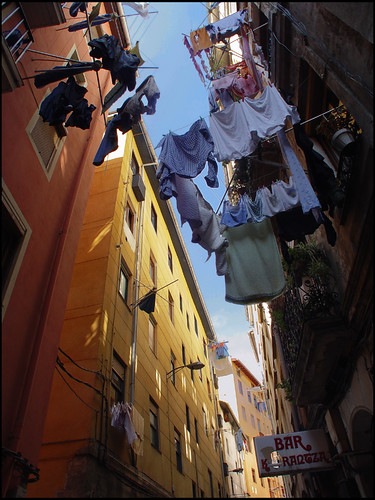
The somewhat whimsical sight of this laundry, dangling high above the street, really, really makes me want to be traveling right now. Aside from that, my main reason for posting this is to experiment with the new link that I established between this blog and flickr, allowing me to instantaneously post cool things that I run across while exploring that site.
Monday, October 11, 2010
Red brick schoolhouses
Inspired by this fun book, a fascinating website that Jimmy shared with me, and a recent visit to the Washington Historical Society, I decided to rebrand some of my previous posts with a new label. Titled Local Color, it is meant to serve as a catch-all for content directly related to the place that I call home, ranging from ruminations on city politics and events to photos from my periodic weekend roamings. More than anything, I hope to capture an appreciation of local history, especially interesting old buildings and institutions, with particular attention paid to the impact (or lack thereof) that it continues to have on our modern lives.
The first, the Wallach School, was located on Capitol Hill. It was a grand-looking building with a capacity of 600 students, named for the mayor who spearheaded this reform effort. A prototype for many others that followed, the Wallach School gained international recognition as a model for urban public schooling. It operated until the mid twentieth century when, unfortunately, it was razed and replaced with a modern building (the Hine Junior High School) that has since been abandoned. Many of these historic structures met with this sad fate during this period.
One of the exhibits at the Historical Society is currently dedicated to the preservation of DC’s 19th century school buildings, particularly the Franklin School, off of K Street downtown. Fresh off seeing Waiting for Superman, the maladies of our nation’s public schools were planted prominently in my mind when I visited. I thought the film was very well done, though rather than inspire me with the sweeping possibility of education reform, it instilled in me a dire, depressing sense of helplessness.
By contrast, in the 1860’s, the District helped to pioneer the evolution of American public education from the single-room schoolhouse to a model that resembles our present-day system – large buildings with classes separated by age. The city engaged architect Adolf Cluss, whose mark can be found on many notable city buildings, including Eastern Market, to design several of these facilities.
 |
| Wallach School |
Of the handful that remain are the Sumner School at 17th & M NW, still in use, and the Franklin School, which currently sits empty. Even after students left, the District’s school administration offices were housed there until they outgrew the space in the 1960’s. Since then, the school was used briefly as a homeless shelter but its future is now uncertain. The building graces the eastern side of Franklin Square, nestled among modern high rise offices - a reminder of a rustic age gone by, when DC’s public education system was at the forefront of the world, instead of a national disgrace.
 |
| Franklin School |
 |
| Sumner School |
Saturday, October 9, 2010
The shade of someone else's grace
Driving through the townships near Thokoza, South Africa on a chilly June day, Nate took it upon himself to introduce us to all sorts of out-of-the-mainstream hip hop. One of the best, in my opinion, was this collection of remixes from K'NAAN and producer J.Period. They teamed up to create a series of three releases, dubbed "The Messengers," each incorporating and paying tribute to a transformational artist.
My favorite is the third - Bob Dylan (the other two being Bob Marley and Fela Kuti, an influential Nigerian activist musician). It is pretty cool to hear Dylan's very recognizable guitar riffs transformed into beats with a modern, urban flair and to have his famous lyrics interspersed with K'NAAN's rapping. Alongside some of the hip hop remixes are brief, crisply assembled introductory pieces and biographical sketches, providing interesting historical and social context to the music.
You can download all three of the releases, for free, from J.Period's website. Grooveshark has them as well, although Youtube only seemed to have a few (not including my favorite, "Don't Think Twice"). In searching for this music online this morning, I came across this post from NPR's All Songs Considered Blog. There are several sound clips of an interview with K'NAAN, as he discusses the motivation behind the project and the humble approach he takes to paying tribute to these icons.
My favorite is the third - Bob Dylan (the other two being Bob Marley and Fela Kuti, an influential Nigerian activist musician). It is pretty cool to hear Dylan's very recognizable guitar riffs transformed into beats with a modern, urban flair and to have his famous lyrics interspersed with K'NAAN's rapping. Alongside some of the hip hop remixes are brief, crisply assembled introductory pieces and biographical sketches, providing interesting historical and social context to the music.
You can download all three of the releases, for free, from J.Period's website. Grooveshark has them as well, although Youtube only seemed to have a few (not including my favorite, "Don't Think Twice"). In searching for this music online this morning, I came across this post from NPR's All Songs Considered Blog. There are several sound clips of an interview with K'NAAN, as he discusses the motivation behind the project and the humble approach he takes to paying tribute to these icons.
"There is never a way you can improve an original, becuase you don't know what it was meant to be," he says. If not to improve upon it, then what was your goal? wonders the interviewer. K'NAAN answers simply: "To be in the shade of someone else's grace....as a narrator and [to] explain how they connect" to each other and to our lives in the present.
Friday, October 8, 2010
Much tastier than it looks
Wednesday's combination of crisp weather and my ongoing struggle to get rid of a nasty cold seemed perfectly tailored for soup - always one of my favorite foods to bump back into my diet every fall. So I set about cooking a non-creamy mushroom soup that I first attempted last spring, with a few modifications. Very delicious, although dreary and very brown in color without the spinach (which I did not have this time). As with many things, I'm finding that proportions for soup recipes are pretty fluid - you can generally use what you have on hand or what sounds appealing at the time with great results.
Wild Mushroom Soup
Wild Mushroom Soup
- Slice 1 onion or several leeks. Saute in a soup pot until soft with some olive oil or butter.
- Chop and throw in about 1 lb. fresh mushrooms, any combination. I used about half baby portabella, diced, and half shittake, sliced. Saute until soft.
- Pour in 1/2 c. cooking sherry or marsala wine. Boil and allow to reduce by about half.
- Add about 8 c. chicken stock and bring to a boil. Lower heat and simmer.
- Reconstitute 1 oz. dried wild mushrooms in the simmering soup. I used oyster mushrooms. If you don't have them, you can just use an additional 1/2 lb. of fresh mushrooms in step 2.
- Simmer for at least 15 minutes, making sure the dried mushrooms are soft.
- Pour in approximately 1 c. orzo or other small pasta. Simmer until tender.
- Season with salt and black pepper to taste.
- Stir in chopped parsley and a handful of fresh spinach leaves before serving, if you have them.
Thursday, October 7, 2010
October, once again
As this blog lumbers into its third year of existence, I’m still mostly happy with what I’ve managed to piece together here. This afternoon, I took advantage of some of Google’s new design tools and updated my template a bit. With that will, I hope, come a renewed focus on posting content. It would be nice to write more often, as my pace in 2010 has been fairly sedentary. But overall, as a collection of glimpses of moments in my life and the world, I think this blog serves its purpose well.
One of the things I noted the last time I reflected on this effort was how much enjoyment I took away from reading friends’ blogs. I mused that this had become a backdoor way of keeping in touch with people who I don’t get to see regularly and that the mere knowledge that we occasionally read each others’ thoughts instilled a subtle sense of closeness. Unfortunately, save Tom, who has continued posting about his life in New York and his evolving career as a stroller-parking playwright, all of my friends’ blogs have gone quiet lately. If I had to name one regret for the year, it would be that.
Otherwise, all is good in my corner of the blogosphere, as well as in Washington, where we are in store for a beautiful, sunny, 70 degree fall weekend. Soon the leaves will sport all sorts of glorious colors and I will carve a pumpkin.
Wednesday, October 6, 2010
The soft smell of Christmas trees
It is a about an hour's hike, tromping along at a brisk pace, from the train station in Moselkern, Germany to the magnificent Burg Eltz, a castle that has been owned by the same family for hundreds of years. With a little imagination, the walk there feels more like an adventure, through dense forests that could be populated with creatures from the Lord of the Rings. As the path winds on, the ground becomes padded with fallen pine needles and the air takes on a distinct, pleasant air of Christmas. It's possible I only enjoyed this experience so much because I was traveling alone, but I'd prefer to think that this forest has some sort of innate appeal of its own.


Subscribe to:
Posts (Atom)