This map, posted on a website called Visual.ly is a graphic look at America's major interstates, represented as numbered subway lines. Very compellingly done, in my opinion. Also, for some reason, visualizing highways as commuter train lines seems to shorten sprawling cross-country distances into very manageable journeys. As in: if I just hopped on the Blue Line toward Houlton and transferred to the Green Line in Boston, I could be in Seattle in no time.
To see a larger, higher resolution copy, visit Visual.ly directly and click on the map.

Showing posts with label Etc.. Show all posts
Showing posts with label Etc.. Show all posts
Sunday, March 25, 2012

Tuesday, February 14, 2012
Dinner with some true loves
To celebrate Valentine's Day, my roommates and I sat down for a candelit dinner with some of the true loves of our lives: meatloaf and mashed potatoes. Broccoli tagged along too, just for kicks.


Thursday, January 19, 2012
All that we see or seem
As I've noted before, I love when I am up early enough to hear the Writer's Almanac. The poignant poem for today, Edgar Allan Poe's "A Dream Within a Dream," nearly brought me to tears in the car. Although, maybe that says more about me than the poem.
Take this kiss upon the brow!And isn't the music beautiful? Rest in peace, Jim.
And, in parting from you now,
Thus much let me avow—
You are not wrong, who deem
That my days have been a dream;
Yet if hope has flown away
In a night, or in a day,
In a vision, or in none,
Is it therefore the less gone?
All that we see or seem
Is but a dream within a dream.
I stand amid the roar
Of a surf-tormented shore,
And I hold within my hand
Grains of the golden sand—
How few! yet how they creep
Through my fingers to the deep,
While I weep—while I weep!
O God! Can I not grasp
Them with a tighter clasp?
O God! Can I not save
One from the pitiless wave?
Is all that we see or seem
But a dream within a dream
Friday, December 23, 2011
On planes and seeing the world
With a giant hat tip to Andrew Sullivan, whose Mental Health Break posts have connected me with so many beautiful, contemplative videos over the past several years, here are two more pieces that are sweeping in scope and imagination. Also, for aesthetic purposes, though I am posting this on January 9, I am going to back-date it to December, before I left for Istanbul, because I did not have any new entries that month and I am a little neurotic about that.
Heliotropes (2010) from Michael Langan on Vimeo.
Heliotropes (2010) from Michael Langan on Vimeo.
Tuesday, November 22, 2011
Organized chaos
Unfortunately,
I don’t often have the opportunity to listen to Public Radio International’s The
World, which airs locally Monday - Thursday on WAMU at 8 pm. The program features an hour of in depth
reporting about global topics – both current events and interest pieces, like
NPR’s newsmagazines. I try to tune in
when I’m alone at home, often while making and eating dinner.
Last
night’s broadcast featured a brief profile of a new art form springing up in post-revolution
Tunisia called collaborative painting.
One artist starts a painting, and up to five others join in. Anyone can jump in at any time, and all are
free to paint over anything that has already been painted. Described in the piece as organized chaos,
the exercise often results in a work of art that could have easily been
produced by a sole artist. This ability
of an organically evolving group effort to mimic the talent of an individual is
fascinating.
Over
the past several days, I’ve been reconsidering my desire to go to Egypt,
Jordan, and Israel next spring or fall in favor of a possible trip to
Tunisia. That swing through the Middle
East is still exceptionally appealing, but Egypt has some significant issues to work out
related to the role of the military in civilian government that seem farther
from resolution than I thought and some suggest that Jordan may be
teetering on the brink. Tunisia, on the
other hand, held laudably open and non-violent elections last month.
I
do not fear traveling to countries working through the aftermath of the Arab
Spring and, indeed, am doubly excited by the prospect of observing the birth
and growing pains of fresh democracy.
Ongoing violence and civil unrest, however, is likely best avoided.
Wednesday, November 2, 2011
Two pumpkins
Fall is in the air. Two pumpkins: one from a can off the shelf at Safeway, one from a roadside stand just down the road from Sugarloaf Mountain in rural Maryland. The former we made into homemade ice cream, which is now chilling in the freezer. The latter, I carved into this sky-gazer of a jack-o-lantern. Happy belated Halloween!


Thursday, October 13, 2011
For love of country?
Sadly (for the sake of my education), I am not writing about this book. That would require actually having read it in college when assigned to do so as part of the ARHU curriculum, which definitely did not occur.
Instead, the tale of something refreshing I recently discovered: I stumbled on the challenge.gov site a couple of weeks ago, following a link in a friend's gchat status. On it, the government offers challenges that address some area of public need, ranging from creating video PSAs to developing a more energy efficient lightbulb. The competition is open to all and winners receive cash prizes.
I would imagine that, among those with the skills to create some sort of worthwhile innovation, this website is widely known. Never having heard of it before, though, I was kind of shocked that the big, creaky, slow moving federal government was capable of producing such a fresh, nimble-seeming collection of opportunities to change the world. This strikes me as exactly the sort of thing we should be doing, and makes me wonder if this crowd-sourcing-for-smart-people model could hold promise for other types of societal and organizational needs.
Many of our nation's most creative, ingenious people have no inherent interest in public sector work, often justifiably so. In my opinion, increasing their engagement and capitalizing on their many talents can only be a good thing for the country.
Instead, the tale of something refreshing I recently discovered: I stumbled on the challenge.gov site a couple of weeks ago, following a link in a friend's gchat status. On it, the government offers challenges that address some area of public need, ranging from creating video PSAs to developing a more energy efficient lightbulb. The competition is open to all and winners receive cash prizes.
I would imagine that, among those with the skills to create some sort of worthwhile innovation, this website is widely known. Never having heard of it before, though, I was kind of shocked that the big, creaky, slow moving federal government was capable of producing such a fresh, nimble-seeming collection of opportunities to change the world. This strikes me as exactly the sort of thing we should be doing, and makes me wonder if this crowd-sourcing-for-smart-people model could hold promise for other types of societal and organizational needs.
Many of our nation's most creative, ingenious people have no inherent interest in public sector work, often justifiably so. In my opinion, increasing their engagement and capitalizing on their many talents can only be a good thing for the country.
Friday, August 12, 2011
All the joys of traveling
These three videos, titled Move, Learn, and Eat, capture three of my favorite things about traveling: the excitement of soaking in fresh new places, the unique way traveling inspires me to learn about history in a way no textbook ever has, and devouring delicious, local foods, obviously. Created by three friends traveling around the globe for more than a month and posted on Vimeo by director Rick Mereki, the films provide glimpses of 11 different countries and were commissioned by STA Travel Australia.
If nothing else, it really makes me want to travel (not that I needed any extra motivation).
MOVE from Rick Mereki on Vimeo.
LEARN from Rick Mereki on Vimeo.
EAT from Rick Mereki on Vimeo.
If nothing else, it really makes me want to travel (not that I needed any extra motivation).
MOVE from Rick Mereki on Vimeo.
LEARN from Rick Mereki on Vimeo.
EAT from Rick Mereki on Vimeo.
Friday, July 1, 2011
Ice cream cones for everyone
One of my co-workers forwarded me a link to this great photo gallery. The artist, Peter Funch, calls his project "Babel Tales." Over the course of several years, Funch would stand in the same location in New York City for weeks at a time, photographing hundreds of passers-by against the same backdrop. Later, he superimposed individual scenes on top of each other, combining the real images to create a surreal scene.
So, instead of the mix of tourists, street vendors, and businesspeople that you might expect to see populating a shot of Times Square at any given hour, Funch presents a series of images featuring only crouching photographers, or only people posing for pictures. Similarly, streets become filled with chefs, dog-walkers, or people dressed in white. From the description of the project on Funch's website:
So, instead of the mix of tourists, street vendors, and businesspeople that you might expect to see populating a shot of Times Square at any given hour, Funch presents a series of images featuring only crouching photographers, or only people posing for pictures. Similarly, streets become filled with chefs, dog-walkers, or people dressed in white. From the description of the project on Funch's website:
His uncanny work raises questions of reality contra fiction and challenges our notion of photography as being a depiction of a certain moment in time.
This is a particularly fascinating concept to me, since I value photography (and, for that matter, blogging) for precisely this reason. Pictures and blog posts can preserve feelings and emotions that memory would otherwise allow to fade away. Funch's work counters this idea with fantastical scenes that you would normally associate only with the movies. Except his images are actually, at least somewhat, real. Viewing the gallery is thought provoking and vaguely unsettling but, overarchingly, very, very cool.
 | ||
© Peter Funch 2011 |
Sunday, April 24, 2011
Drawing with crayons on eggs
Managed to find some time this afternoon, in between church, the farmers' market, mowing the lawn, and preparing for family dinner to indulge in an Easter favorite of mine: dyeing eggs. I particularly like drawing on them with crayon beforehand (so much so that I made a special trip to CVS to buy a pack of Crayolas for almost $3), because of all of the creativity it inspires.
Until relatively recently, I lacked the context to celebrate Easter for religious reasons. Dyeing eggs has always featured prominently in my understanding of this holiday and it continues to do so. I find it comfortingly childish and, admittedly, really fun. Moreover, the bright colors and happy spirit of the whole exercise seems in keeping with everyone's joyful mood on this day. The challenge now, I guess, will be to eat a dozen hard boiled eggs in the next few days before they go bad.
Happy Easter!

Until relatively recently, I lacked the context to celebrate Easter for religious reasons. Dyeing eggs has always featured prominently in my understanding of this holiday and it continues to do so. I find it comfortingly childish and, admittedly, really fun. Moreover, the bright colors and happy spirit of the whole exercise seems in keeping with everyone's joyful mood on this day. The challenge now, I guess, will be to eat a dozen hard boiled eggs in the next few days before they go bad.
Happy Easter!

Friday, November 19, 2010
Isolated bursts of color
Walking home from the Metro earlier this week, I noticed something peculiar. It had been a wet, miserable day, and drizzle was still slipping from the sky in forlorn little spurts. There were a lot of leaves on the ground, freshly pulled from branches by the wind and rain. But instead of melding into the slippery mess of the scene, they popped, with stunning effect.
Maybe it was the concentrated piles of leaves, gathered on the sidewalk underneath each tree like the glow of a street lamp. Or perhaps it was just the bright autumn colors, held in such sharp contrast to the prevailing grayness of the day. Regardless, I have never been so soundly struck by something's beauty on an otherwise gloomy Tuesday afternoon.
 (more - and better - pictures to come)
Maybe it was the concentrated piles of leaves, gathered on the sidewalk underneath each tree like the glow of a street lamp. Or perhaps it was just the bright autumn colors, held in such sharp contrast to the prevailing grayness of the day. Regardless, I have never been so soundly struck by something's beauty on an otherwise gloomy Tuesday afternoon.

Friday, November 12, 2010
The land of the elves, and other amusing things
I can't pretend to understand the science underlying this discovery, but I find it stunning nevertheless. Taiwanese researchers have found that injecting the leaves of trees with gold nanoparticles causes the chlorophyll within them to emit a warm, reddish glow. The discovery has sparked interest as both a potential biological alternative to some of the highly toxic materials in popular LED lights and as a futuristic, yet natural, way to illuminate roads without energy-leeching streetlamps.
This is all very impressive but, what truly captures my imagination is the thought of forests of ephemerally twinkling trees, similar to Lothlorien in the Lord of the Rings. I'm picturing epic hikes through the woods, or perhaps a treehouse nestled among the luminous foliage. Very, very cool.
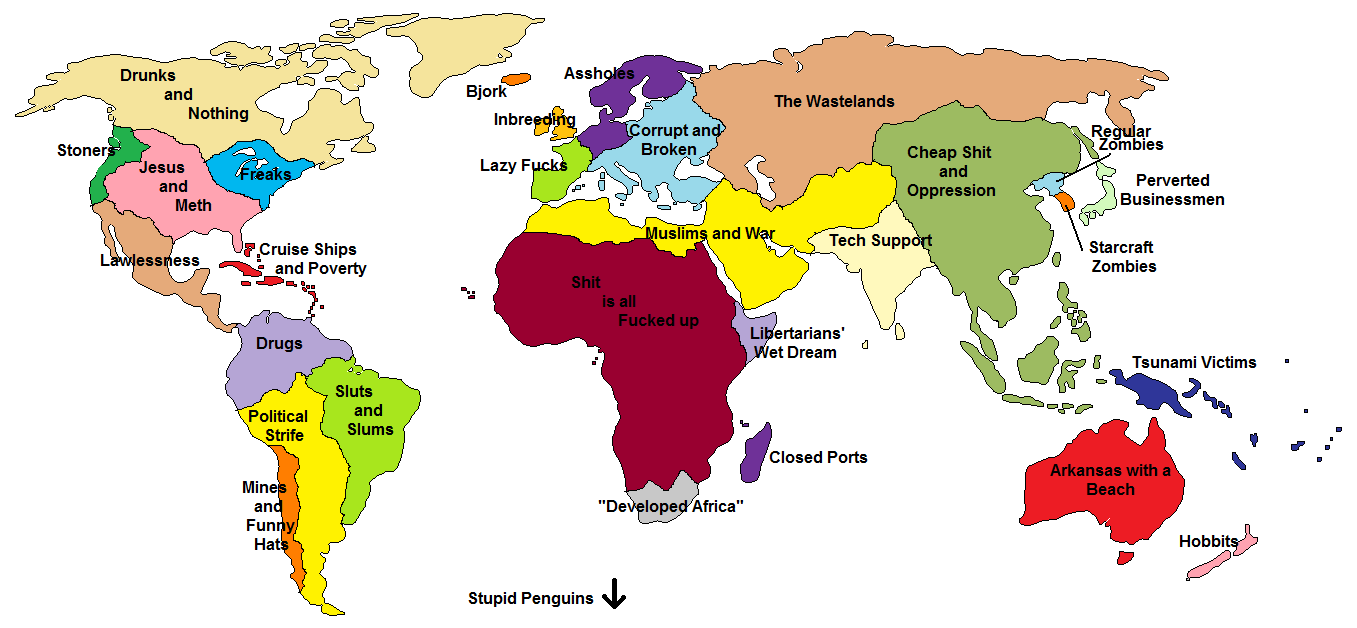
Another thing that made me smile today, though for a completely different reason, was this tongue-in-cheek map (courtesy of Sarah), parodying stereotypes that many Americans hold about various regions of the world. I felt like a jerk while reading it, but it's hard not to laugh at the phrase "Libertarians' Wet Dream."
This is all very impressive but, what truly captures my imagination is the thought of forests of ephemerally twinkling trees, similar to Lothlorien in the Lord of the Rings. I'm picturing epic hikes through the woods, or perhaps a treehouse nestled among the luminous foliage. Very, very cool.
Another thing that made me smile today, though for a completely different reason, was this tongue-in-cheek map (courtesy of Sarah), parodying stereotypes that many Americans hold about various regions of the world. I felt like a jerk while reading it, but it's hard not to laugh at the phrase "Libertarians' Wet Dream."
Friday, November 5, 2010
In a bookstore near you

I came across this hilarious pamphlet in Barnes and Noble last night. The inside features a list of "secret" two letter country codes, corresponding to the first two characters on diplomatic license plates. For only $3.99, you can own this guide and help your country identify and track suspected foreign spies. Countries deemed dangerous are listed in red ink, so that you can be particularly wary of these dignitaries.
Despite the inclusion of the USSR on the list, this brochure does not appear to be a joke. It was located among traveling books and maps, not kitsch-y prank gifts. I pity the idiot that buys this thing, if, for no other reason, because I'm sure all of this information is available for free online. Amateur counter-espionage agents can save themselves four bucks.
Sunday, October 31, 2010
Toothless in his old age
Though only six days old, with the spat of unseasonably warm weather last week, my jack-o-lantern is becoming elderly in pumpkin-time. He began with a toothy, somewhat sinister looking grin, with huge, dodgy eyes and furrowed brows. The eyes are still there, but the formerly pointy teeth, four on top and two on the bottom, have shriveled backwards into his head. Regardless, he has held up well enough and will be illuminating our steps tonight, as costumed little kids and opportunistic teenagers stop by for some candy. Happy Halloween!

Thursday, October 21, 2010
Fall membership campaign
Those three dreaded words are back in style at WAMU this week, meaning that, instead of crisp, insightful programming, my commute is filled with a parade of local on-air and behind the scenes personalities begging for donations of "whatever you can afford - maybe $1,000, maybe $5 a month." I am actually fairly tolerant of these bi-annual (tri, if you count the spring's Morning Edition-only version) annoyances - I recognize the great importance of listener donations to the success and quality of public radio. However, there is one thing I cannot bear.
Pat Brogan really needs to calm down about Marketplace. Perhaps it's just because my commute often straddles the 5:45 - 6:00 zone, when his excitement is reaching its peak, but I feel as though he raves about little else. The title Marketplace is frequently linked with the words "my favorite program" or "one of those shows where they just take something that could be so confusing, so tough to grasp, and make it just so digestible and so clear for everyone."
Although I mostly agree with this assessment of Marketplace's value and understand how difficult it must be to speak constantly about giving money (call 800-248-8850 or visit wamu.org) without sounding like a broken record, surely Pat Brogan can grasp that the same people listening to 88.5 FM at 5:40 in the DC area are probably still listening at 5:43, 5:47, and 5:55. By the fourth or fifth glowing mention on the fourth or fifth consecutive night of the campaign, I think everyone gets it: he loves Marketplace.
I will most likely donate before the week is out. But it will not be because of Brogan's clumsy, repetitive prattling. And, if he could somehow promise to vary his pledge-drive commentary even a little bit, I would be tempted to give quite a bit more.
Pat Brogan really needs to calm down about Marketplace. Perhaps it's just because my commute often straddles the 5:45 - 6:00 zone, when his excitement is reaching its peak, but I feel as though he raves about little else. The title Marketplace is frequently linked with the words "my favorite program" or "one of those shows where they just take something that could be so confusing, so tough to grasp, and make it just so digestible and so clear for everyone."
Although I mostly agree with this assessment of Marketplace's value and understand how difficult it must be to speak constantly about giving money (call 800-248-8850 or visit wamu.org) without sounding like a broken record, surely Pat Brogan can grasp that the same people listening to 88.5 FM at 5:40 in the DC area are probably still listening at 5:43, 5:47, and 5:55. By the fourth or fifth glowing mention on the fourth or fifth consecutive night of the campaign, I think everyone gets it: he loves Marketplace.
I will most likely donate before the week is out. But it will not be because of Brogan's clumsy, repetitive prattling. And, if he could somehow promise to vary his pledge-drive commentary even a little bit, I would be tempted to give quite a bit more.
Monday, October 18, 2010
Redwoods of the east
Many people, it seems, have some underlying sense of the tragedy of the great American Chestnut tree. Fondly called the “Redwoods of the East,” billions of these majestic trees once covered the East Coast, Appalachian range, and Ohio Valley, comprising up to one quarter of the trees in these deciduous forests. Mature American Chestnuts frequently stood 100 feet tall with massive trunks up to 10 feet in diameter. With such an imposing profile, useful hardwood, and delicious nuts, the trees are folded across the lore of American history, art, poetry, and music
A devastating foreign fungal blight struck in the early twentieth century, rotting the insides of the chestnut trees and causing the majority to disappear by 1950. Ever since, conservationists have been trying, mostly in vain, to develop a way to combat the blight and bring back the lost eastern icon. However, through a careful process of cross breeding with blight-resistant Chinese Chestnut trees and back-breeding with the American species, scientists seem to be getting closer. They have developed a tree that is more than 90% American in genetic make-up, but maintains the fungal resistance of its Chinese cousins.
One of the most poignant pieces of this Post article tells of how the roots of the once mighty trees still live underground, so saplings will frequently crop up in the woods, only to be destroyed by the still lurking blight. But now, conservation groups, working together with the federal government, are beginning to introduce the cross-bred trees into the wild. It will take many hundreds of years for them to grow to full size, which makes me sad, but hopefully this marks the start of the American Chestnut’s return.
A devastating foreign fungal blight struck in the early twentieth century, rotting the insides of the chestnut trees and causing the majority to disappear by 1950. Ever since, conservationists have been trying, mostly in vain, to develop a way to combat the blight and bring back the lost eastern icon. However, through a careful process of cross breeding with blight-resistant Chinese Chestnut trees and back-breeding with the American species, scientists seem to be getting closer. They have developed a tree that is more than 90% American in genetic make-up, but maintains the fungal resistance of its Chinese cousins.
One of the most poignant pieces of this Post article tells of how the roots of the once mighty trees still live underground, so saplings will frequently crop up in the woods, only to be destroyed by the still lurking blight. But now, conservation groups, working together with the federal government, are beginning to introduce the cross-bred trees into the wild. It will take many hundreds of years for them to grow to full size, which makes me sad, but hopefully this marks the start of the American Chestnut’s return.

Tuesday, October 12, 2010
Air dry
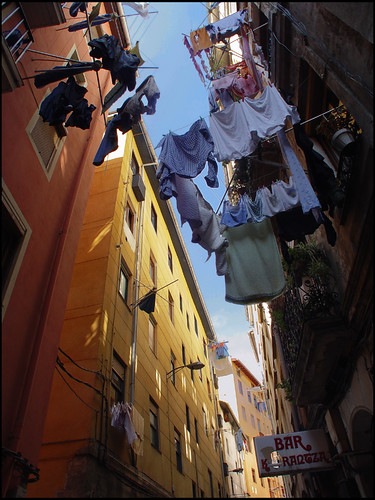
The somewhat whimsical sight of this laundry, dangling high above the street, really, really makes me want to be traveling right now. Aside from that, my main reason for posting this is to experiment with the new link that I established between this blog and flickr, allowing me to instantaneously post cool things that I run across while exploring that site.
Thursday, June 24, 2010
Even I know how to play "Heart and Soul"
Public art, like so much else that is generally cultured and worthwhile, must tread a fine line between seeming inspired and pretentiously pointless. On the way home last night, I heard about the “Play Me I’m Yours” project in New York City on the radio, and definitely feel that it fits into the former category.
British artist Luke Jerram has been sprinkling collections of creatively decorated pianos on the streets of major world cities and observing how people react. Some noncommittally tap out a few bars and move on, while others become wholly engrossed, playing recital pieces and improvising as they go.
This reaction makes complete sense. Despite not having ever taken any lessons, the instrument holds a certain sway over me. Growing up, I would sit at my parents’ piano and pick out tunes, key by key – simplified versions of movie scores and classical pieces, the Maryland Victory Song, and more. What is most appealing about the piano, however, is its accessibility. More so than with any other instrument, you can walk up to almost any piano – in the lounge of hotel, in a friend’s living room, or, now, on a street corner of New York – and entertain either a crowd or yourself, for a couple minutes or a couple hours.
Jerram was inspired to start this project by seeing the same people, over and over again, in the laundromat. Everyone recognized each other, but no one spoke. Assuming that these types of situations existed everywhere, he envisioned the pianos as a way to jumpstart conversations that might otherwise go unspoken. I only wish I had a reason to be in New York in the next two weeks. Maybe the next city Jerram chooses will be DC.
British artist Luke Jerram has been sprinkling collections of creatively decorated pianos on the streets of major world cities and observing how people react. Some noncommittally tap out a few bars and move on, while others become wholly engrossed, playing recital pieces and improvising as they go.
This reaction makes complete sense. Despite not having ever taken any lessons, the instrument holds a certain sway over me. Growing up, I would sit at my parents’ piano and pick out tunes, key by key – simplified versions of movie scores and classical pieces, the Maryland Victory Song, and more. What is most appealing about the piano, however, is its accessibility. More so than with any other instrument, you can walk up to almost any piano – in the lounge of hotel, in a friend’s living room, or, now, on a street corner of New York – and entertain either a crowd or yourself, for a couple minutes or a couple hours.
Jerram was inspired to start this project by seeing the same people, over and over again, in the laundromat. Everyone recognized each other, but no one spoke. Assuming that these types of situations existed everywhere, he envisioned the pianos as a way to jumpstart conversations that might otherwise go unspoken. I only wish I had a reason to be in New York in the next two weeks. Maybe the next city Jerram chooses will be DC.
Sunday, May 23, 2010
A moment in May
The New York Times' Lens Blog recently sponsored a really cool project. Called "A Moment in Time," it is a collection of photos that people around the world submitted. All were taken at the same time, 11:00 am Eastern, on Sunday, May 2, 2010. The resulting mosaic is inspiring.
Impressive in both scope and execution, this project provides a broad glimpse of life on Earth. You can browse the shots by geographic area or by theme. Some of the photos are loaded with emotion. Others are quick snapshots, bolstered by strong composition and nice camera work.
While it's enlightening to be able to peer momentarily into the lives of people everywhere, it's also, global significance aside, simply a collection of fantastic pictures. Check it out.

Impressive in both scope and execution, this project provides a broad glimpse of life on Earth. You can browse the shots by geographic area or by theme. Some of the photos are loaded with emotion. Others are quick snapshots, bolstered by strong composition and nice camera work.
While it's enlightening to be able to peer momentarily into the lives of people everywhere, it's also, global significance aside, simply a collection of fantastic pictures. Check it out.
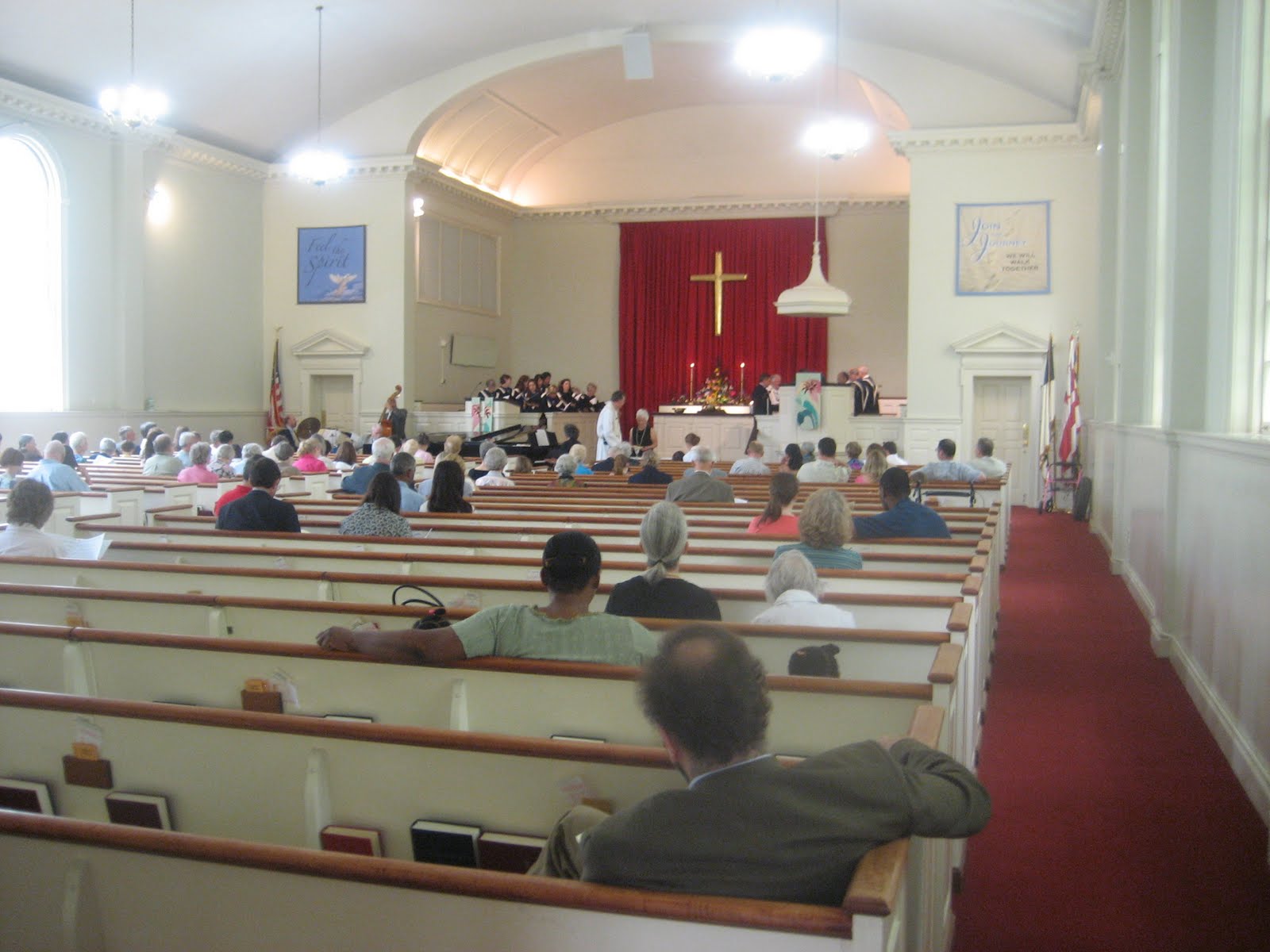
My contribution to the project is below. I had just finished teaching Sunday school and had snuck to the back of the sanctuary to take a quick picture. I wish I had been able to photograph something a little more interesting than a church congregation, but I guess part of the point is to document your life at that particular moment in time.
Tuesday, March 30, 2010
Alter ego
Alter Ego, by photojournalist Robbie Cooper, has been floating around on several different blogs. Its premise is a side-by-side comparison of people and their avatars. These fabricated online identities offer insight into each person's self. Some illustrate actual qualities - physical features and perceived personality traits exaggerated to sometimes comedic cartoonish effect. Others pretty clearly represent desired characteristics.
I think each piece is a fantastic expression of the human spirit, as well as a testament to the power of photography as an art form. Kudos to the authors for a couple of very creative, thought-provking ideas. The image below (copyright Robbie Cooper) is one of my favorites that was posted online.

It's fascinating, revealing, and, in some cases, heartbreaking to see these juxtaposed images. The fact that Cooper's book includes detailed profiles of each of the pairs reminds me a lot of another coffee table book that I really enjoy: The Oxford Project. Similar to Alter Ego, this collection of photos by Peter Feldstein compares images of the residents of a small midwestern town, taken 20 years apart. Each person was given the opportunity to talk a little bit about his or her life, proud accomplishments and weighty disappointments alike. Though I suppose it's possible that I'm just projecting the contents of the text onto the images, I swear you can see these emotions reflected subtly in some of the photos.

Subscribe to:
Posts (Atom)