
Monday, December 27, 2010
The best Christmas gift
Well, taking time spent with family and good friends out of the equation, this is the best. Better than new sheets, new slippers, and gift cards (and certainly better than this book, which my brother bought for me as a joke).
Monday, December 20, 2010
Pre-holiday hodgepodge
For some reason, the hectic pace of the holiday season seems to stunt my ability to fully formulate eloquent thoughts. So, in an effort to not completely neglect my blog this December, outlined below are a few things that have been on my mind. I may expand on some of them, either in the lull between Christmas and New Year’s Eve or later down the road, or I may not.
The historic repeal, this past weekend, of the Don’t Ask, Don’t Tell ban on gays serving openly in the military pleases me - both because the policy was discriminatory and detrimental and because it will quiet some of the annoying squawking coming from the left. Though I don’t inherently care as much about this aspect of gay rights as, say, marriage equality, it is, nevertheless, a momentous step in the right direction for our country.
On the topic of Congressional action, I’ve also been very happy with the pace and bipartisan nature of the “lame duck” session. Since returning to Washington after the elections, Congress has gotten quite a bit done: a tax deal and economic stimulus that angered the more ideological wings of both parties (which, to me, makes it all the more appealing), progress toward a vote on the crucial New START nuclear arms reduction treaty with Russia, and, of course, the aforementioned DADT repeal. The failure of the Dream Act is truly disheartening and New START is not yet ratified, but, for once, pragmatism has seemed to characterize the overall course of events in Washington more than frustrating partisan gridlock (with some notable exceptions).
In a break with the child-like excitement of years past, I reacted to this season’s first snow – a small one, at that – with a sense of barely contained distaste. Perhaps a remnant of last winter’s blizzard fatigue, perhaps simply an indication that I have become a 25 year old curmudgeon.
I have not yet read this book, recommended by Andrew Sullivan, but, as an imaginative exercise in philosophies and interpretations of the afterlife, it sounds fascinating. Thought-provoking excerpts here.
Egged on by a candy-filled advent calendar and the abundance of sweets that show up on the office’s kitchen table during the holidays, I find myself recently unable to resist the following things: Reesee’s Peanut Butter Cups, chocolate chip cookies, ginger cookies, and cupcakes.
It alarms me, in a somewhat glum, existential way, that 2011 is just two weeks away.
Recently, I received the first hard copy in my subscription to The Atlantic. Occasionally, I am struck with frivolous ideas when it comes to reading – that I should buy a non-fiction book based on the interesting-sounding description on the back cover, without first investigating reviews and verifying its readability, for example, or the perpetually incorrect assumption that I possess the patience and intellectual curiosity to fully digest an issue of The Economist. I’m hoping The Atlantic does not fall victim to a similar fate - so far, I’m doing ok.
Michael Giacchino’s beautiful score from Lost continues to delight and haunt me, six months after the series finale. Grooveshark allows me to listen whenever I am the mood for a transportively emotional experience.
Given the proper appetite and a particularly tasty batch, I could probably eat an entire carton of Clementines.
Over the past week, the way that Maryland has treated head coach Ralph Friedgen, an alum who led the program back to national relevancy a decade ago, is despicable. He deserves better than to have unnamed sources from the university fuel rumors about his status, particularly after orchestrating a huge turnaround season and winning ACC coach of the year. Most dishonorable, to me, is the conduct of our new A.D., Kevin Anderson, who earlier this season definitively confirmed Friedgen’s job security for next year and now, as of this afternoon, has officially reneged on his show of support. This has been handled unreasonably poorly and, combined with the basketball team’s mounting losses and the heartbreak of the premature end to soccer season, has sapped most of my enthusiasm for Terps sports (for now, at least).
I’m disappointed that tonight’s lunar eclipse is going to happen while I’m asleep.
Life is far too fleeting to give up, even temporarily, the pursuit of happiness.
Friday, December 3, 2010
Fall in the Capital 2010
A few weeks ago, I wrote with wonder about the striking nature of autumn colors on a rainy afternoon. But, truthfully, there are endless ways to appreciate my favorite season. As we transition into the long, cold winter, this is my homage to fall.


Wednesday, November 24, 2010
Our world is cruel and beautiful
If I pay attention, I find that I am reminded on an almost daily basis of just how fortunate I am. Just the other morning, I read an article about the record number of families that are now facing “food insecurity” (many of them very recently middle class), and how that is stretching resources at area food pantries very, very thin. Our world is stricken with quite a bit of heartache, and, to date, I’ve been blissfully shielded from much of it.
Though I always attempt to maintain a sense of humility about my place on this Earth, it is shamefully easy to lose perspective. But stories, like the one I read earlier today, and firsthand experiences both have a uniquely illustrative power to lend context and poignancy to life’s many abstractions. Particularly with the approach of Thanksgiving, this helps to bring what is often otherwise latent gratitude into sharper relief.
In this sense (and many others), one of the more meaningful things I’ve done over the past year is travel to South Africa. Though my two weeks of volunteering were, in all likelihood, far more impactful on a personal level than on a practical one, it was an experience that I will carry with me for the rest of my life. I have been meaning to write more fully about my time there since June. With the hope of sharing even a fraction of all that I took away, Thanksgiving seems as good a time as any.
After zooming around the country for a little over a week on the left side of the road (literally – I’ve received two separate email notifications from Thrifty that my credit card would be charged for speed camera violations), Dave and I arrived in the township of Zonkizizwe, about 45 minutes southeast of Johannesburg. We slept there for a week, volunteering for Vumundzuku-bya vana (VVOCF), which means “Our Children’s Future” in Zulu, and spent a second week commuting to Zonki every day from Johannesburg.
After zooming around the country for a little over a week on the left side of the road (literally – I’ve received two separate email notifications from Thrifty that my credit card would be charged for speed camera violations), Dave and I arrived in the township of Zonkizizwe, about 45 minutes southeast of Johannesburg. We slept there for a week, volunteering for Vumundzuku-bya vana (VVOCF), which means “Our Children’s Future” in Zulu, and spent a second week commuting to Zonki every day from Johannesburg.
 |
| VVOCF: Shipping containers, a dirt yard, and love |
Some background: VVOCF is a resource and support center dedicated to children who have been made vulnerable by HIV and AIDS. Though this disease has orphaned most of the kids who attend, the center itself is not an orphanage. The kids live primarily with some combination of aunts, uncles, and grandparents, or, most heartbreakingly, in child-headed households.
 |
| Dinner time! |
Three days per week feature formal programming, intended to nurture, educate, and entertain the youth, helping them to reach their full potential. There is also a free (and delicious) hot meal – often the only one these kids get all day. The center helps obtain school uniforms and distributes donated clothes. Overarchingly, it works tirelessly to destigmatize and raise awareness about HIV/AIDS, and helps ensure that HIV positive children receive the care they need to survive and thrive. Even on the off days, when the center is not technically open, many children congregate and play there, which, to me, speaks volumes about VVOCF’s important place in the community.
Dave and I helped with all of this, splitting our time between having fun with the kids and doing behind-the-scenes administrative stuff to support the center - organizing for grant proposals and setting up a more efficient accounting spreadsheet, for example. With several months in Zonki, I think we could have made measurable progress on some of these initiatives, particularly a large scale study of VVOCF’s efficacy. However, with only two weeks, we faced many limitations (complicated further by the lack of available resources, such as a reliable computer).
The children themselves are wonderful. Particularly with the younger ones, it's so easy to forget what dire circumstances all of them face. They are so loving and happy, and were genuinely excited to do anything with us - reading, arts and crafts, beating us at soccer, etc. Reality begins to set in, though, when you have conversations with some of the older kids about their aspirations. Growing up as they have, these kids have not had chance or reason to think about their future. Self-empowerment is one of the goals of VVOCF, but all of the good work at the center cannot overcome a lackluster education system in the townships and the 40% national unemployment rate (higher in places like Zonki). It is depressing to observe that, no matter what they do, as these kids grow up, they have very few options to make a living. Even more heartbreaking is the fact that the older kids seem to recognize this.
I thought quite a bit about the most effective way to convey the many nuances of our time at the center and decided, ultimately, to introduce you to some of the characters that we came to know.
 |
| Nomusa and Sne |
Nomusa co-founded VVOCF in 2006 and now runs the center’s day-to-day operations. Though she only has a few years of formal education, she is bright and passionate about caring for the kids, and has a great sense for how to get things done. It is the organizational aspects of running a non-profit center where she needs assistance, which is why we tried to help her with the filing and record keeping systems. Nomusa speaks English fluently, and often focused on teaching the children to read. Her son, Snetemba, was a real terror, in a good way. One time, Nomusa saw streaks of mud running across the side of our parked car. Shaking her head, she mused, “Only Snetemba could have done this.” He liked to shout out vowel sounds: "ah, eh, iii, uh, oo!"
 |
| Spe and Nlanthla |
They sat for awhile and taught us words and phrases in Zulu (indiza is plane, inyanga is moon), laughing at our struggles to pronounce the unfamiliar sounds. Nlanthla asked us to sing our national anthem, and he sang theirs in return: “Nkosi Sikelel' iAfrika,” an old resistance song that translates to “God bless Africa” and was later combined with songs of several languages to form the modern South African anthem. We played the first of many games of soccer in the dark yard, and I took the first of many tumbles on the rocky, packed dirt, luckily avoiding the shards of broken glass and popping up laughing. Later that evening, they took turns reading “Danny and the Dinosaur.” Every night thereafter, they would come and read with us, sometimes after soccer, sometimes after chess. Spe and Nlanthla were key to us feeling welcome in Zonki.
We were specifically tasked with bonding with the older teen boys, since they have very few male role models in their lives. Phakamani was one of my favorites – he challenged us, along with one of his friends, to a two on two USA v. South Africa soccer match (sadly, the USA did not prevail – it was not even close). He and the other teens also kept asking if they could wash our car. Having only been in Zonki for a day or two, we were still getting acclimated and felt vaguely suspicious. But they really did just want to wash the road dirt off of our car. A few times, Phakamani borrowed my camera and ran around taking pictures. Photography is one of my favorite hobbies, and I take the fact that I can practice, more or less at will, for granted.
 |
| Phakamani |
One of the most lasting memories that I’ll keep of Phakamani was a conversation that he had with Kristi and me about his future. As a 17 year old, he is getting ready to graduate from school. We asked him what he wanted to do afterwards and he kind of shrugged, saying that the only thing he does well is play sports. When we followed that by asking if he wanted to stay in Zonki or move away, he responded that he would stay, because “[he has] no choice.” It floored me to realize that, having grown up as he did, in a country with 40% unemployment and still-blatant stratification, Phakamani had never had reason to give much thought to his ideal future. Even poor kids in America grow up with big dreams. It’s cruel and unfair that these kids do not.
 |
| Specihle |
Specihle, another of the teen boys, is 16 and lives in a child-headed household with his twin brother, who no longer comes to VVOCF, and several younger siblings. He told me one time while we were gardening that when he is able to get online, his chat name is “Cool Zulu Boy.” Specihle also expressed disappointment that one of the previous volunteers had forgotten his birthday (July 3), even though he remembered hers. It struck me that, to us, visiting VVOCF is the experience of a lifetime, but that to these kids, our presence is likely depressingly fleeting. After returning home, I made sure to ask Kristi to wish Specihle a happy birthday from me. I want the kids to know that, even half a world away, I think of them often, and that I care about them.
 |
| Wiseman, in the middle |
 |
| M'Longisi |
Wiseman wins the award for best name, yet, for some odd reason, his was one of the names it took me the longest to remember. He was always eager to say hello and one of the first to volunteer to help clean up at the end of the day.
 |
| Chlanchla, Vumile, and Hilda in the kitchen |
Aside from Nomusa, VVOCF relies on the hard work of several adult volunteers. They would gather each morning for a moving, musical prayer. Vumile always seemed particularly tickled when we would ask her “how are you?” in Zulu (unjani). Chlanchla, who actually spoke great English, would only speak to us in Zulu and would often lead the kids in song or dance. Susvina usually cooked the delicious meals, like samp (curried beans and hominy) and lentils over rice. Hilda invited us over to her home to watch the opening game of the World Cup on TV, with her husband Alfred. Because Alfred has a job, they live in a nice house, have a small flat screen TV, opened a bottle of wine to share with us, and own a car. The fact that they still live in Zonki illustrates the fact that today’s townships are home to people of varying means – there are even some mansions in Soweto.
 |
| Weeding in the vegetable garden |
There are so many others that we came to know – Pulile, the sweet girl with the shy smile whose face I painted with the South African flag for the World Cup, Sfizso, the teen boy who ran across a field to help us find the center on our first afternoon and later showed me the addition he was building to his family’s home, the grinning boy in the red snow jacket who, despite the fact that I never was too clear on his name, was one of my favorites, the other Nlanthla, who played soccer barefoot.
 |
| Zonkizizwe |
VVOCF is a place of exceptional hope and love, but also depressing realities. Knowing that the world is full of M’Longisi-s, eager to give hugs, and Phakamani-s, struggling with a lack of opportunity, is utterly heartbreaking. Despite these harsh realities, the inherent goodness of these kids gives me hope for the power of the human spirit to overcome adversity. And, more than anything, it makes me acutely aware of my great fortune. We are all graced with considerable blessings. Happy Thanksgiving.
To learn more about VVOCF, or to donate to the U.S.-based non-profit organization that directly supports it, click here.
Friday, November 19, 2010
Isolated bursts of color
Walking home from the Metro earlier this week, I noticed something peculiar. It had been a wet, miserable day, and drizzle was still slipping from the sky in forlorn little spurts. There were a lot of leaves on the ground, freshly pulled from branches by the wind and rain. But instead of melding into the slippery mess of the scene, they popped, with stunning effect.
Maybe it was the concentrated piles of leaves, gathered on the sidewalk underneath each tree like the glow of a street lamp. Or perhaps it was just the bright autumn colors, held in such sharp contrast to the prevailing grayness of the day. Regardless, I have never been so soundly struck by something's beauty on an otherwise gloomy Tuesday afternoon.
 (more - and better - pictures to come)
Maybe it was the concentrated piles of leaves, gathered on the sidewalk underneath each tree like the glow of a street lamp. Or perhaps it was just the bright autumn colors, held in such sharp contrast to the prevailing grayness of the day. Regardless, I have never been so soundly struck by something's beauty on an otherwise gloomy Tuesday afternoon.

Monday, November 15, 2010
Things that many conservatives tend to forget
Andrew Sullivan pointed me to this piece by David Frum in the New York Times magazine. It is fantastic - thoughtful, realistic, and somewhat damning, without being harsh or overly partisan. Although he is quite conservative from a policy-standpoint, I often find myself drawn to Frum's ideas for their measured, reasonable tones.
In this article, he argues against knee-jerk hypocrisy and closed information systems (think Fox News and MSNBC), among other things, and suggests that newly empowered Republicans and, most importantly, the nation would benefit from more cooperation and less political opportunism. Read it - it's informative and honest.
In this article, he argues against knee-jerk hypocrisy and closed information systems (think Fox News and MSNBC), among other things, and suggests that newly empowered Republicans and, most importantly, the nation would benefit from more cooperation and less political opportunism. Read it - it's informative and honest.
The U.S. political system is not a parliamentary system. Power is usually divided. The system is sustained by habits of cooperation, accepted limits on the use of power, implicit restraints on the use of rhetoric. In recent years, however, those restraints have faded and the system has delivered one failure after another, from the intelligence failures detailed in the 9/11 report to the stimulus that failed to adequately reduce unemployment, through frustrating wars and a financial crash. The message we hear from some Republicans — “this is no time for compromise” — threatens to extend the failures of governance for at least two more years. These failures serve nobody’s interest, and the national interest least of all.
Everywhere we follow
As a college student, I followed the Maryland men’s soccer team very closely. Spurred by my proximity to campus and, more than anything, the stirring community of alums and students that lives and dies with the team’s success, I have continued to attend games in the years since graduation, albeit less frequently. I’ve done some seemingly crazy things over the years for the Terps, mostly related to far-flung road (or plane) trips, made especially inconvenient because of departure time, proximity to exams or holidays, or both.
One thing, however, that I’ve never experienced first hand is an ACC championship. Maryland defeated UNC 1-0 yesterday to take home the trophy (our second in the past three seasons!). For all of the six hour bus trips back and forth to what was once called SAS Soccer Stadium, in Cary, NC, I have never seen the Terps win the conference tournament in person. This weekend was no different, as a visit with David in Middletown, PA prevented me from joining the rest of the Crew on this weekend’s road trip. But my absence couldn’t keep me from getting nostalgic - the victorious celebration, the joyous text messages, the DOTS bus. All make me miss that particular corner of my college experience so, so much.
On the bright side, the Terps are not done. I think this team could be special. This year’s College Cup will be taking place in Santa Barbara in a few weeks. Perhaps, if Maryland can get there, my Southwest voucher will get me there too. Until then, you can find me at Ludwig, cherishing the experience of supporting college soccer’s finest team.
Friday, November 12, 2010
The land of the elves, and other amusing things
I can't pretend to understand the science underlying this discovery, but I find it stunning nevertheless. Taiwanese researchers have found that injecting the leaves of trees with gold nanoparticles causes the chlorophyll within them to emit a warm, reddish glow. The discovery has sparked interest as both a potential biological alternative to some of the highly toxic materials in popular LED lights and as a futuristic, yet natural, way to illuminate roads without energy-leeching streetlamps.
This is all very impressive but, what truly captures my imagination is the thought of forests of ephemerally twinkling trees, similar to Lothlorien in the Lord of the Rings. I'm picturing epic hikes through the woods, or perhaps a treehouse nestled among the luminous foliage. Very, very cool.
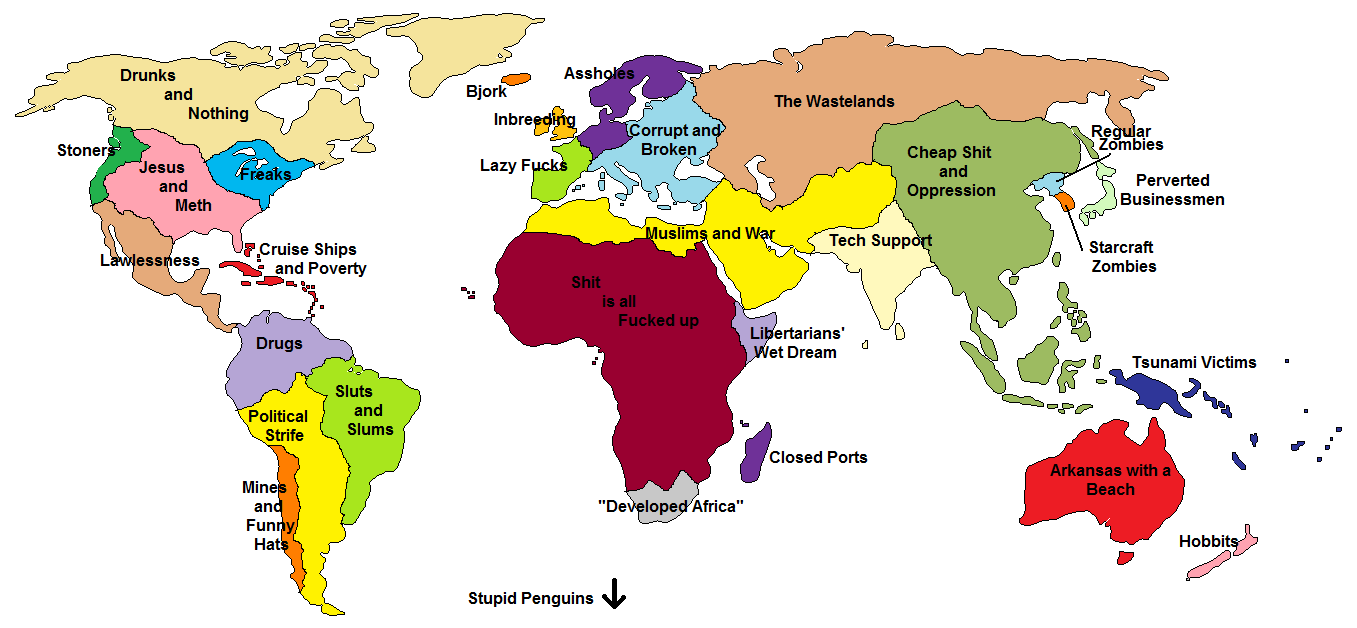
Another thing that made me smile today, though for a completely different reason, was this tongue-in-cheek map (courtesy of Sarah), parodying stereotypes that many Americans hold about various regions of the world. I felt like a jerk while reading it, but it's hard not to laugh at the phrase "Libertarians' Wet Dream."
This is all very impressive but, what truly captures my imagination is the thought of forests of ephemerally twinkling trees, similar to Lothlorien in the Lord of the Rings. I'm picturing epic hikes through the woods, or perhaps a treehouse nestled among the luminous foliage. Very, very cool.
Another thing that made me smile today, though for a completely different reason, was this tongue-in-cheek map (courtesy of Sarah), parodying stereotypes that many Americans hold about various regions of the world. I felt like a jerk while reading it, but it's hard not to laugh at the phrase "Libertarians' Wet Dream."
Subscribe to:
Posts (Atom)